Monday, January 30, 2012

Changing Out the Handlebars - Part II

The paint on the triple tree is dry and we are ready to re-install it.  But first I needed to solve a quick aesthetic / engineering issue.  For that I turned to the mechanical creativity of Eric Bess, the owner of Flying Tiger Motorcycles.  As you can see in the photo below, the triple tree was pinched on either side by a bolt which fed into a nut on the other side of the triple tree.


In the second photo you'll notice that when the clubman handlebars are in position they press against the top of the bolt.  This would eventually cause the handlebars to scratch and grind in that spot, opening the door to other problems.  Also, the bolts in the photo are not stock, so there is no reason to keep them on the bike.

Eric's proposed solution was to tap and drill the holes where the bolt runs and switch to a button-head allen bolt.  This eliminates the need for a nut altogether and, because the button-head has a lower profile than the current bolt, allows the handlebars to sit in position without hitting the top of the bolt. All of that sounded great to me so we did it.


After searching the shop and making a quick run to the hardware store, we realized that we didn't have two identical bolts, but we had two bolts of different lengths that were otherwise identical.  So Eric cut the end off of one of the bolts so they would match.


The bolts were wider than the pre-existing holes so we used the drill press to widen the route for the bolt.

We then pushed the top of the triple tree back onto the front end.

We re-connected the gauges and the ignition to the top of the triple tree and bolted the top of the triple tree into place, but I forgot to take a picture of it so it'll have to wait for next week.  Also waiting for next week are the handlebars which must be marked and drilled for wiring before mounting.  Hopefully we'll be able to get that done and start making progress on the new tail section for the bike.

Monday, January 23, 2012

Changing Out the Handlebars - Part I

I ordered the handlebars on Monday and they arrived on Thursday, so naturally I staged some photos of me taking them out of the box... on Saturday.


Then I headed down to Flying Tiger Motorcycles for some supervised work on the bike.

First we removed the lever controls for the brake and clutch and then we removed the clamps holding the stock handlebars, the hand controls and the throttle housing.


There is wiring running from the hand controls, through the stock handlebars, down by the gauge cluster and under the gas tank.


After unhooking the wiring and threading it back through the stock handlebars they were completely off of the bike and I put the new handlebars in place to make sure they still worked with the bike.


There are a couple of things that have to happen before we can fully install the new handlebars.  First we removed the top of the triple tree to get it cleaned and repainted.


The top of the triple tree was showing its 36 years of use, so it was ready for a nice cleaning.


In order to make this part look like new again I used the bead blaster at Flying Tiger.  This machine shoots a stream silicon beads which are about the same size as grains of sand.  The beads are shot out of a nozzle inside the machine.  The silicon beads provide enough erosion to strip anything off of the aluminum part, but are soft enough to keep from hurting the underlying metal.  

To work the machine you put your hands in heavy-duty gloves mounted to the machine.  If you have seen the opening sequence of The Simpsons where Homer is working then you can imagine how the bead blaster works.  Next to the machine is a vacuum which removes the beads as they are shot out of the nozzle  You look through a window to see your progress.


It doesn't take very long for the metal to be stripped totally clean.


Once the part has been cleaned it is ready for a new coat of paint.  Then it looks like a brand new part.


We put two coats of paint on the top of the triple tree and it needed to dry overnight so we were done for the day.  The next steps are to drill holes in the new handlebars to run the wiring, mount the new handlebars to the bike and reattach the hand controls.  Meanwhile I'll also be working on getting a new seat and tail section.

Saturday, January 14, 2012

Mocking Up the Handlebars

There are lots of clubman handlebars for purchase online, but one never really knows how a certain set of handlebars will look or feel until they are placed on the bike.  Today I had the opportunity to try out a set of clubman handlebars to determine if I should order an identical set.

First I removed the stock handlebars.


I held the stock handlebars up towards the gauge cluster while we fitted the clubman handlebars.  We were specifically looking at seating position, angle of the handlebars and how they affected the turning radius.


Overall I was happy with the length, drop and "pullback" of the handlebars.  After having the great people at Flying Tiger Motorcycles give them a seal of approval I decided to place the order.


As soon as the new handlebars arrive it'll just be a matter of transferring the grips and controls.  The bike will then have taken her first step towards becoming a cafe racer.

Saturday, January 7, 2012

The Beginning

Today I have done two things which I had never done before: I started a project to build a cafe racer and I tried to design a blog about it.  I have a feeling that both experiences will be more time-consuming than I had originally anticipated.  But hopefully, when both experiences are complete, I will be proud of my work and satisfied with the results.

The idea for a cafe project began a couple of months ago.  I was already the proud owner of a 1976 Honda CB750 Super Sport which had been restored by the previous owner: the great folks at Flying Tiger Motorcycles in Maplewood, Missouri.  With a bike so cleanly preserved, I couldn't bring myself to start changing seats, handlebars, or paint.  The 750 is perfect just the way it is.

So I began looking around for a smaller motorcycle which, while mechanically sound, had enough aesthetic issues to justify alteration.  Fortunately I have a very supportive and beautiful wife who was willing to let me fund and undertake a cafe project even though I already have a perfectly functional bike that I love.  I proposed a budget and started checking the internet for a bike that would work as a cafe racer.

I told the great people at Flying Tiger that I was thinking of taking on a cafe project and they pointed out a 1976 Honda CB400F which had recently been brought into the shop for some routine work and which the owner wanted to sell to fund his own restoration projects.  

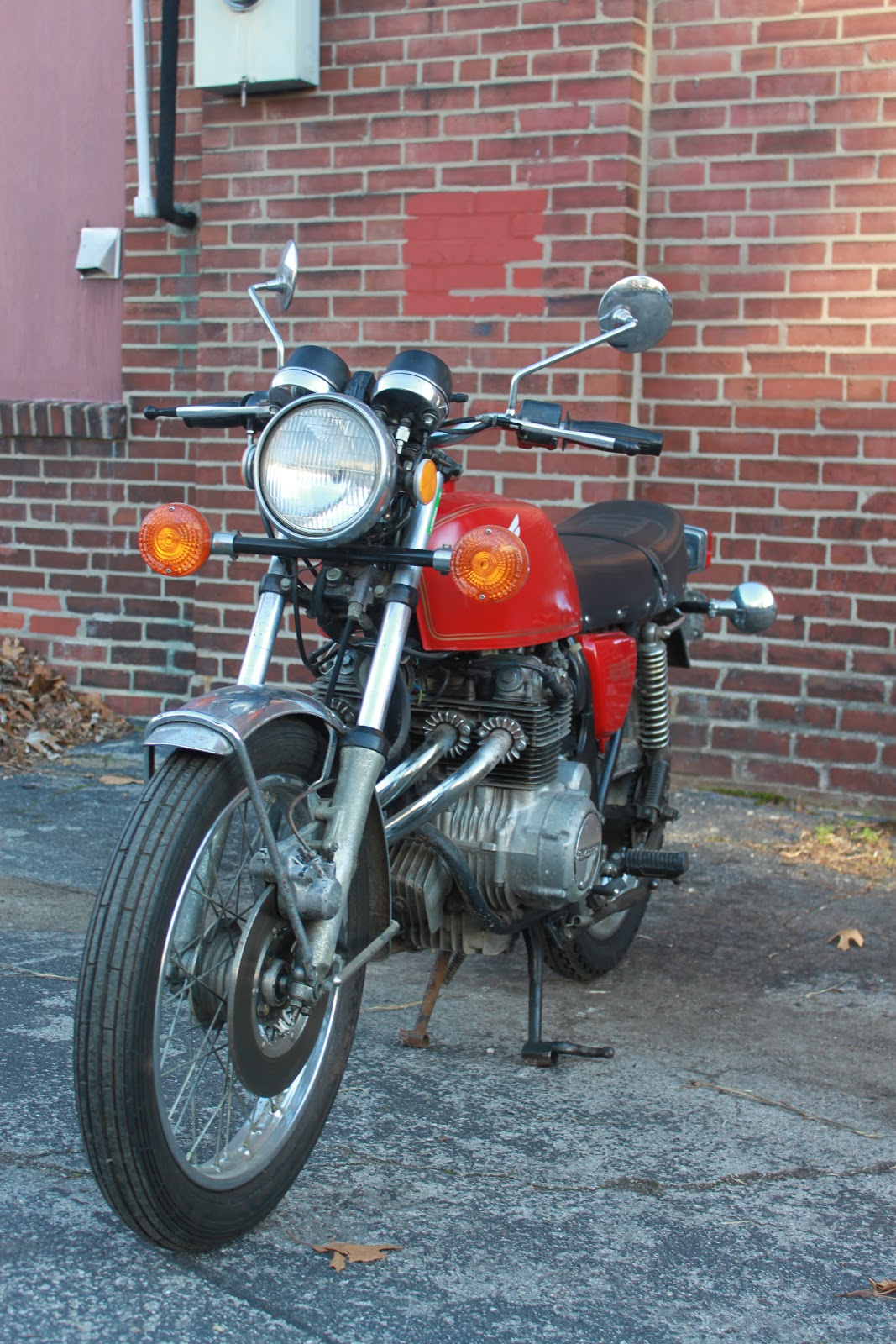
As soon as I saw it I knew it would make a great cafe racer.  It has the same flat profile as my larger 750 and a similar engine.  In fact, it looks very much as if someone has thrown hot water on my 750 and it shrunk by about 20%.  Moreover, Flying Tiger informed me that it has no mechanical or electrical problems.  It is a perfectly running bike, albeit with some aesthetic issues.  There is a tear in the seat and the decals on the gas tank are starting to peel off.  It needs a new paint job and there is some rust spotting on the fenders and chain guard.  In short, this bike is exactly what I was seeking.  I contacted the bike's owner, we negotiated a purchase price, and we completed the sale after a test ride.

If I have learned anything from motorcycle and car customization shows (not to mention late-night diet pill commercials) it's that when you start a project like this you have to take "before" and "after" photographs.  The pictures you see below are the "before" photos.  This is how the bike looked at the time of purchase and how it looks at the time of this writing.


The plan is to change the look of the bike without changing the structure of it.  It will get a new paint job and new graphics on the tank and side cover (which won't be Honda graphics).  It'll get a new seat and tail section which will probably include a new tail light.  Lastly, it will get new handlebars to complete the cafe racer look.

I would like to have this done by the Spring and I think a target date of April 30, 2012 is reasonable.  But as I said at the start, it will probably take longer than I anticipate and I'm interested to see what challenges arise.  Whatever the challenges, when it is done I expect that it will be a sleek and nimble cafe racer.  Most importantly, it will be my cafe racer.

I will continue to take photographs and write blog entries as the project progresses to document each step.  For now I feel like the bike and project need a name other than "the cafe project."  I was thinking of calling it "little sister" since it is so closely related to my CB750.  Any other suggestions?